How do young B2B startups learn from external knowledge? My master's thesis at the University of Twente (2015) looked at the early stages of absorptive capacity – recognising the value of outside knowledge and acquiring it. For research it extends the absorptive capacity concept; for founders it is a lens on validating a startup and finding product-market fit.
Download the thesis (PDF) University of Twente record
Theory
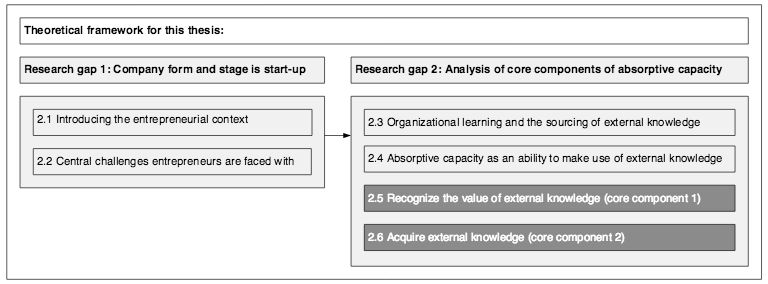
The framework starts with the special characteristics of startups, followed by an in-depth analysis of absorptive capacity in the startup context. It builds on the model of absorptive capacity by Todorova & Durisin (2007).
Method
16 of 89 relevant B2B startups took part in semi-structured interviews between late July and mid-September 2014. Interview partners were founders in leadership roles:
Findings
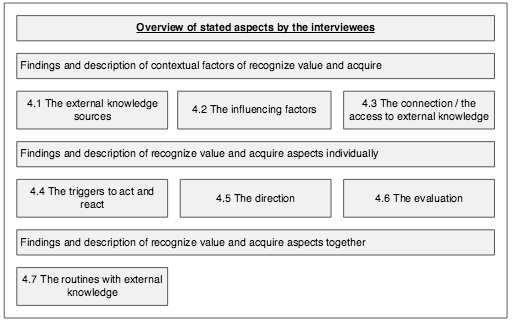
The research focused on the early components of absorptive capacity: recognising the value of external knowledge and acquiring it. The chart shows contextual aspects, specific dimensions of both components, and routines that had to be investigated together.
Discussion
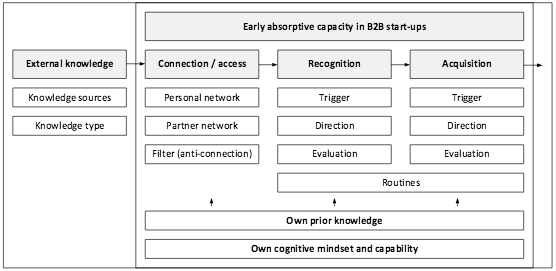
In contrast to the established concept of Todorova & Durisin (2007), interviewees strongly highlighted a further dimension: connection to and access to external knowledge.
Entrepreneurs frequently stressed how important external knowledge is for their challenges – above all knowledge about the market.
With these findings, actors in the startup ecosystem get a framework to reflect on how they learn from external knowledge – and how to get better at recognising and acquiring it.
Glossary
- Absorptive capacity
- The ability of a firm to “recognize the value of new information, assimilate it, and apply it to commercial ends”. Cohen & Levinthal
- Business model
- “A business model describes the rationale of how an organization creates, delivers, and captures value.” Alexander Osterwalder
- Job to be done
- “When customers find that they need to get a job done, they hire products or services to do it.” Clayton Christensen
- Lean startup
- A way of developing new products that emphasises fast iteration and customer insight, combined with a huge vision and great ambition. Eric Ries
- Minimum viable product
- The smallest set of features that elicits customer feedback – at first maybe just a slide, a video or a demo. Steve Blank
- Product-market fit
- “Being in a good market with a product that can satisfy that market.” Marc Andreessen
Thank you
For supervision, support, critique and feedback: Dr. Rainer Harms, Dr. ir. Sandor Löwik and Dr. Annika Lorenz.