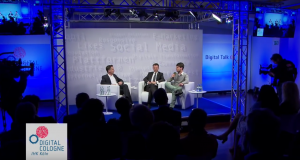
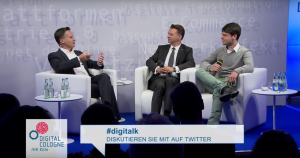
On 20 June 2016, the Digital Talk series of the Cologne Chamber of Industry and Commerce (IHK Köln) asked: are startups a flash in the pan, or lasting momentum for the digital economy? Journalist Richard Gutjahr discussed this with four guests – starting with what startups mean for tomorrow's Mittelstand.
Mittelstand refers to Germany's small and medium-sized, often family-owned companies. This is an English translation of the German transcript published in 2016.
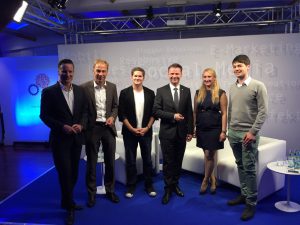
On the panel
- Richard Gutjahr – journalist, moderator
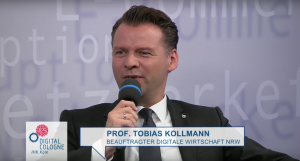
- Prof. Tobias Kollmann – University of Duisburg-Essen; Commissioner for the Digital Economy NRW
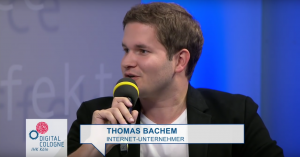
- Thomas Bachem – serial founder, CODE University
- Kanika Kaltenberg – founder of Zuckerzahn
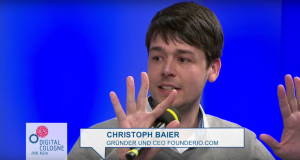
- Christoph Baier – founderio and Ambi-Vation
Watch the talk
Videos are hosted by YouTube, Vimeo or TED. Nothing loads from these services until you press play.
Digital Talk 06: full recording
The complete panel discussion at IHK Köln.
Digital Talk 06: summary
The highlights of the evening in eight minutes.
Key takeaways
- 70% of Mittelstand companies had no digital strategy – the problem is no longer awareness but implementation.
- Startups can act as an outsourced R&D unit: experiment on protected ground while the core business still runs.
- Both sides speak different languages – shared vocabulary and mutual understanding come first.
- Route cooperation through R&D, innovation and business development – not through purchasing.
The transcript
Richard Gutjahr
Can you explain to us: what exactly is the definition of a startup? What makes a startup a startup?
Prof. Tobias Kollmann
There are about 80 different definitions of startups in the literature, and honestly I don't care which one we use, as long as there are enough of them. Because we urgently need them. Whether they may only be five or ten years old, whether they work in innovative industries or not, whether they are founded by teams or not – all of that is irrelevant. The main thing is that they exist. Of course startups matter, because that is where tomorrow's jobs are created. And hopefully being a startup is a temporary phenomenon, because they are supposed to grow and one day become the Mittelstand. On the other hand, hopefully it is not a fad, because there should be as many as possible, now and in the future – they will become an essential pillar of our future.
Richard Gutjahr
Tobias, you have a mandate not only at the university but also from the state government. What exactly do you do? Tell us a bit about your work.
Prof. Tobias Kollmann
I have the great honour of wearing several hats. I am a professor at the University of Duisburg-Essen and try to teach my students how to found companies and develop startups in the digital economy. At the same time I am the Commissioner for the Digital Economy of North Rhine-Westphalia, with a staff unit at the Minister of Economic Affairs, Garrelt Duin, who has not only made this his cause but is pushing it forward very positively. He gave me the chance, together with an advisory board of practitioners, not to write yet another agenda – we don't need that – but to develop a concrete catalogue of measures. Over the past months we have launched a whole range of things, and today was another of those meetings. Right now our DWNRW hubs are in focus: our platforms for developing startups on the one hand, and for bringing them together with the Mittelstand and industry on the other.
Richard Gutjahr
You have launched five hubs that are meant to pool and share knowledge. You'd think everything on the internet is decentralised – from a coworking space in Berlin or Hamburg you can serve the whole country or the whole world. Why is it still so important to be present regionally?
Prof. Tobias Kollmann
First, because NRW is a large state: we are not one city, we are spread out across the region. Not only the startups, but above all the Mittelstand and industry. If we really want to focus on our strategy of bringing startups, the Mittelstand and industry together, then we have to go where they are. That's why we chose a distributed approach rather than a single one, and we meet people where they are. Especially for the Mittelstand that is very real, because they are not that digital yet: 70% of all Mittelstand companies don't have a digital strategy, so we have to pick them up, and we do that through the distributed hub structure, which is linked at a higher level. This means a startup from Aachen can work just as well with a Mittelstand company in East Westphalia as an industrial company from Bielefeld can with a startup from Cologne, because they are organised through the hub. That is our particular approach: we don't want to open yet another coworking space, but a concrete hub for brokering projects. Business comes first – we want to bring together those who are already there so that they generate digital revenue together. That is our goal.
Richard Gutjahr
That is probably also the difference between us in Germany and Silicon Valley: they can start on a greenfield, while we already have existing industries and need to make sure we equip them locally?
Prof. Tobias Kollmann
Yes, there's that great saying that we lost the first half, especially in B2C. The second half could be all about B2B, and there we have something to show. If we manage to bring digital startups and their innovations together with our classic established economy, which still has access to the markets, then we could make something of the second half. That is the path we want to take in NRW. I'm not excluding any B2C startup – if you think along the chain B2B2C, we have end-to-end digital value chains we can serve. But perhaps, in contrast to the hip locations, our task in NRW is this down-to-earth digital work of taking our Mittelstand and industry along.
Richard Gutjahr
We probably won't catch up with Google, Facebook and co., but in networking industry – Industry 4.0 – we can probably still turn things around?
Prof. Tobias Kollmann
Yes, and it's not only a question of Industry 4.0 and more IT in companies, but also of bringing together the platforms and the different players for digital business models. Only if we build the front-end platforms on the web that generate demand – demand that the Mittelstand and industry can then fulfil – do we stand a chance. We must not retreat to the idea that in future we will perhaps only have the physical world market leaders. We need them in digital too. There is a thesis that the next digital world market leader from Germany will be a physical one – if it manages to digitalise. Startups will hopefully help with that.
Richard Gutjahr
We just heard that 70% of Mittelstand companies have no digital strategy at all. Why is that?
Prof. Tobias Kollmann
Because the know-how and competence aren't there yet – the leaders and thinkers haven't yet recognised what is happening on the web and what it makes possible.
Richard Gutjahr
Are we still doing too well?
Prof. Tobias Kollmann
That too. Above all, they are only slowly noticing that some revenue is being lost. I always use this image: our captains of industry are standing on the deck of the real Titanic toasting each other, while the digital iceberg has long been in sight. There are already forecasts that Germany will drop out of the top ten economies if we don't manage to tackle digitalisation, especially for the Mittelstand and industry. I believe startups play an essential role here: they create pressure on the one hand, and at the same time they help established industry that doesn't yet know exactly how it works. If we bring the two together, we have a unique selling point and a real competitive advantage for Germany in the future.
Richard Gutjahr
Can't you just sit back and say: when the senior hands over the company, it will happen automatically?
Prof. Tobias Kollmann
I don't think simply waiting is a good option – in the sense of "the next generation will sort it out". It has to be done now, because this field moves so fast. The average reaction time to these disruptive digital challenges is two years. In two years internet startups have already achieved an incredible amount – just think of Airbnb, Snapchat and all the others. So we can't wait for a generational change in five to ten years; we have to deal with it today. That's why managing directors, board members and owners of family businesses have to engage with the topic today.
Richard Gutjahr
What can concretely be done to speed up this process? What do you recommend to the Minister of Economic Affairs here in NRW?
Prof. Tobias Kollmann
With the Digital Economy initiative in NRW we have already achieved a lot. We've got the topic into people's heads; we no longer have a problem of awareness but one of implementation, and the digital hubs are meant to be a key milestone for that. We also have other measures: early-stage financing programmes for startups, and bringing startups to trade fairs so they become known nationally and internationally. We have a large networking programme where regional networks can apply for funding to bring the topic even more into the region. And we have communication and events – this year we will hold a DWNRW Summit in Essen to draw attention to ourselves. Taken together with the next ideas, we are giving the state a digital update that isn't finished but has started. It will take time, it won't happen overnight, but we have begun, and that puts us ahead of many other federal states.
Richard Gutjahr
It all started 15, 16 years ago: you founded your first company, sold it, and then again and again. Don't you get bored?
Thomas Bachem
No – that's exactly why not.
Richard Gutjahr
Is it an addiction that grabs you? "I have to found, I made it once, let's see if we can do it again"?
Thomas Bachem
Yes, you could say that. Of course it's also very much about the goals you set yourself, and a lot about recognition. Especially in the internet industry, where I work, so much is in motion that you constantly get new impulses and new ideas and want to move new topics. I've been doing this for almost ten years now – I started doing startups more actively at almost 19 – and it often feels like an eternity because there have been so many different stages.
Richard Gutjahr
What's the appeal for you? How does it start – you have an idea, and then?
Thomas Bachem
That is what's the most fun, especially at the beginning. I find it incredibly fascinating to dare to enter a market. I have always deliberately chosen new markets – internet-focused, but with different focal points. First I naively look at what others are doing and question it. People often say: everyone said it couldn't be done, then someone came along who didn't know that and simply did it. That's sometimes how it feels. You don't have to be – you shouldn't be – an expert to change things. I approach it above all with lots of conversations; over the years I've discovered my passion for talking to people, networking and seeking exchange. Then, step by step, the insights come, and after half a year you laugh about how clueless you were half a year earlier.
Richard Gutjahr
So a bit of naivety can even be useful when you start fighting your way through where others said it can't be done?
Thomas Bachem
Absolutely, and I mean all the big internet companies started that way. Nobody had the plan "I'll build Facebook, the multi-billion corporation". It starts with small ideas – "I'll do this project" – and something grows out of it.
Richard Gutjahr
What haven't traditional entrepreneurs grasped yet? How the web works today? Where are the biggest obstacles, where do you meet resistance – "that may work for you, but it's not for us"?
Thomas Bachem
That's a good question. I talk a lot with large companies, but I always find it very hard. What I hear very often, as Tobias said, is that the awareness is there, but not the knowledge of the exact possibilities and the implementation. More and more often I hear: "I understand all that, but I have a bunch of 50-year-old employees who have worked for us forever, and it's so hard to get them to change." How can I manage that? I'm the wrong person to ask, because I haven't faced that challenge myself. I was lucky to often work with young people starting from a blank page, and I see it as a very special challenge where I'm still somewhat at a loss.
Richard Gutjahr
It seems to me they speak two different languages. How can a government succeed in getting them to mix?
Prof. Tobias Kollmann
Not the government itself at all – we built the hub structure so that management on the ground can do it. Of course that management needs the competence: it has to speak the language of the Mittelstand and industry on the one hand, and be hip enough on the other for startups to get their chance. What matters is that we keep creating these interfaces and keep pointing out that this is no voodoo, no mystery, but can be learned with competence and tackled with employee training. On the other side there is young, fresh blood brought in by startups through cooperation, and the confidence to simply try it. That's what we are trying to initiate here – to be, from our role, an engine for the process of bringing these sides together.
Richard Gutjahr
You are committed to coding, you want people to learn to code. Why? Aren't there enough coders, or are they the wrong ones? Why is it so close to your heart?
Thomas Bachem
Both: there aren't enough, and in part they are the wrong ones. Why it's so close to my heart has to do with my own story. I've been a self-taught software developer since my early teens – I don't even remember exactly how it happened. At some point I was fascinated not just by using the computer but by creating software myself. I taught myself, first from books, later from the internet itself, and that's how many of the developers we employ and who work in startups today got there – they are self-taught. Studies even say the vast majority are. When it came to deciding after school whether and what to study, the obvious computer science degree really put me off, because it's very theoretical, very fundamentals-based, very mathematical – I sometimes say it's more applied mathematics. It had little to do with what I knew. For me software development is a creative process, a lot of teamwork too, and that never came across. I ended up studying business administration but always wondered: how can this be? Why is there nothing like that? That was eleven years ago. Internationally a lot is happening: coding education needs to be much more practical and taught separately, in addition to computer science degrees. I want to bring that to university level and found a private university.
Richard Gutjahr
That's the CODE University. From what age does it make sense to get children in touch with it? And we should talk about gender balance – there's a lot of catching up to do there, too.
Thomas Bachem
I said there are too few – that's easy to understand – and in part the wrong ones. Or rather, not the wrong ones: I think we can reach entirely new target groups. Girls and women are a very big part of that. On average the share of women in computer science degrees in Germany is around 20%, and none of us knows exactly why. It's similar in many other technical degrees, but I think computer science conveys this very mathematical, very dry image. It can and should be completely different. In practice it is a team sport on the one hand and something incredibly creative on the other. When we looked into why there are so few girls, unfortunately girls come into contact with computers less already in their youth, and when it's time to choose a degree they feel "I'm already so far behind, the boys know more than I do", and they feel intimidated. Those are all problems we want to solve. With school students, I think you can't start early enough. Many parents send their children to piano and ballet lessons – why not once a week to computer or programming lessons? One challenge, of course, is that there are still far too few offers in this area. What we want to do, for example, for young people aged 15 and up: in the autumn holidays we are running a big programming camp here in Cologne, the Codecamp. We want to set new accents, reach new target groups and show the kids that this is really damn cool and not burdened with the clichés people often have in mind.
Richard Gutjahr
Camps like that exist in Germany, mostly in Berlin. Hamburg invests a lot in its startup scene. How do you rate Cologne?
Thomas Bachem
Unfortunately you have to say that compared with Berlin, Hamburg and Munich, Cologne is lagging behind. I think we know that. It's due to the same huge challenge Tobias is working on: NRW is a large, spread-out state. We see not only the trend towards urbanisation in general but perhaps also towards metropolisation, and in the startup scene it is simply very popular to live in big cities. We have many of those in NRW, but they are very spread out. If you put NRW together – all the startups and innovative projects we have – we could easily keep up with the others, but not each city on its own. That makes it very hard at the moment.
Richard Gutjahr
Could you imagine programming becoming part of the curriculum, say as a second or third foreign language? Instead of Latin?
Thomas Bachem
Yes, absolutely. I didn't take Latin myself, so I have to be careful here. You always have to be very careful when you want to cut something. I also question whether religious education belongs in school – for many topics people say that's the parents' job; such things can well be the parents' job too, I think. I find it very hard to say what belongs in and what doesn't. But what I find very sobering is that, due to the federal system, every school is a bit different, and I never had a technology subject at school either. Germany is supposedly the land of engineers and mechanical engineering – where is that taught at school? School teaches the fundamentals: physics, maths, chemistry and so on. But what is really exciting and can motivate young people incredibly is working on real projects. I would find it much more exciting to have a technology subject where you build a robot and look at it mathematically, physically and from a programming perspective. But even this technology subject, which we should have had for decades, we almost never have. That's why I sometimes fear it will take a long time for software development and coding as a subject, too.
Richard Gutjahr
What's the story behind this pink stand?
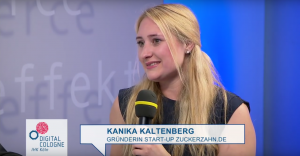
Kanika Kaltenberg
My business partner and I discovered that mobility was missing in the events sector, especially when it comes to sweets. So we developed an idea for bringing sweets – or marketing strategies in general – to people in a modern way.
Richard Gutjahr
So two years ago you had an idea and said: we have to revolutionise the sweets market? That's how you always have to talk when you found a startup, right? You say you are a mix of startup and founder – what is the startup part of you?
Kanika Kaltenberg
We didn't found the company just to found something, but because we really had the idea and wanted to push it forward. That is our startup spirit.
Richard Gutjahr
That's what Thomas said: it's not about wanting to become a multi-billion-dollar corporation, but about asking why doesn't this exist yet – let's just do it. Doing more than talking?
Prof. Tobias Kollmann
Yes. Thoughts alone have never broken a window – doing comes first here. That's also what I always tell my students: we can discuss as many correlations as we like, but at the end of the day it's about doing. And that, by the way, is not only something you learn as knowledge; you also need some courage to do it. So I admire everyone who takes that step and makes a difference with a startup.
Richard Gutjahr
You were also brave enough to take your idea to TV. There's a show called "Die Höhle der Löwen" (the German "Dragons' Den") on VOX, and you pitched there. What was it like?
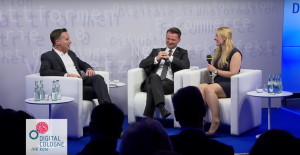
Kanika Kaltenberg
Of course it was totally exciting. We had never been in a situation where we had to present ourselves to someone, or even justify who we are, what we do and why we do it. We were curious – we were in the first episode of the first season, so we had no idea how the show would be received or whether we would be edited nicely. We were glad to be part of it.
Richard Gutjahr
And you had a goal: you were still very young and wanted money – founding capital, you could say. It was 50,000 euros, but you didn't get it. Why?
Kanika Kaltenberg
Yes, I think we presented ourselves well, everyone was happy with us and said it was a great company – but that we could make it on our own. There doesn't necessarily need to be an investor behind it; we should rather work our way up and then make our own decisions, because maybe not every investor can live with pink all the time, for example – but we can.
Richard Gutjahr
And in hindsight you haven't regretted it at all, because now that you are growing independently, not so many people have a say.
Kanika Kaltenberg
Yes, that's of course an advantage for us – we only have to argue between the two of us.
Richard Gutjahr
At the beginning you said it all started very hands-on. Describe the situation: you basically had some savings, and now you have employees. How did it really start?
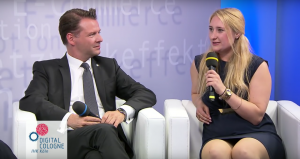
Kanika Kaltenberg
On the show we were still wearing self-sewn, self-painted costumes and had trolleys. We have since replaced all of that with designer dresses that we developed with designers in Germany and had produced here, and the trolleys too – they are now high-quality and come from a factory here in Germany. The handmade sweets: before, we only worked with Haribo; there, too, we have kept improving, and that's where I really notice our success.
Richard Gutjahr
Today you have a handful of employees. What are the plans now? You want to expand catering with sweets and achieve something at some point?
Kanika Kaltenberg
We don't really have a plan; we like to see what the next day brings. Of course we also think big and plan big – we want to keep growing and expand.
Richard Gutjahr
Basically that's also a dream. I think the Ministry of Economic Affairs also only wants to give a push and create jobs. Is that your goal too – to stimulate, but not to subsidise permanently?
Prof. Tobias Kollmann
I think pure subsidies are never a good instrument in the long run, so that's exactly it: we want to give a kick-start so that as much as possible develops. But it also has to be competitive, and I think that is very important for a startup as feedback – that the market actually demands what is produced. I also think it's a very good example of not only thinking about the very big companies that achieve a lot – though an awful lot fail on the way. Perhaps a hundred down-to-earth startups that can employ a handful of people in the long run are also a good goal that we can make good use of in NRW. I like to talk about honest digital graft in the west of the republic, and I'd rather have a lower failure rate and fantastic founders who make a lasting difference. Because that's important. Let's not kid ourselves: there are forecasts that digitalisation will destroy many jobs but also create many new ones. These will be created especially in new fields, which is why we have to keep an eye on them.
Richard Gutjahr
So we need a healthy Mittelstand – not only Facebooks and Googles. Perhaps comparable to the automotive industry, where you say we also need suppliers?
Prof. Tobias Kollmann
Yes, exactly. It's a mix: on the one hand we need big lighthouses – and we have them; think of Trivago, one of the biggest digital players here in NRW – but we also need the background hum of a digital Mittelstand that provides a solid base across the board and is therefore robust. Because if a big one gets bought and relocated – that does happen in this industry – then perhaps we haven't reached our goal. That's why it's important that we also shine in these structures.
Richard Gutjahr
Kanika, we've already talked about gender balance. Do you have an explanation for why women don't find founding so sexy?
Kanika Kaltenberg
I don't believe that at all. I think many women found companies quite successfully and enjoy it. New media in particular have made it so easy to found something – something you're interested in. And there really are many points of contact now.
Richard Gutjahr
You weren't the coder either, so we are still moving in classic territory. You do catering; in travel or marketing you also meet many female founders. But real coding – among developers it's 80-20, I even know 90-10 – women are still hesitant. What would have to happen for women to say "I can code"? What put you off? Was it, as Thomas said, too technical, too abstract?
Kanika Kaltenberg
I'm really the wrong person to ask, because I know nothing about it. It would probably have to be simplified, with nicer pictures in it.
Richard Gutjahr
Apple now wants to bring coding into schools in the USA and has even created its own platform so that even children, preschoolers, start coding. I've noticed that a war for talent is going on in the USA: they know good coders are expensive and lure them with perks. We still have a lot of catching up to do in Germany, don't we?
Prof. Tobias Kollmann
Yes, but there are first signs. The Standing Conference of Education Ministers has just decided that programming should become one of the four basic cultural skills in schools, alongside reading, arithmetic and writing. So it has been recognised. I find that very remarkable – it isn't implemented yet, but at least it has been recognised. Of course, when you discuss curricula there are many different views: from a more general subject of "digital studies" in primary school that covers not only programming but also the societal understanding of what is happening there, to programming as a second foreign language alongside a continued subject of digital studies or computer science to deepen the skills, up to universities – with special activities like the programming universities Thomas Bachem just mentioned, but also where the digital economy is embedded in the STEM subjects, business informatics, computer science and business administration at the interface, including the development of startups and innovations. There are incredibly many approaches, and the next IT summit in our state will also address this topic, because the interface between business and education is so incredibly important. We in NRW are also trying to set a lot of impulses.
Richard Gutjahr
What you are building is very classic, rather analogue. How important are sales and the internet? Are you considering opening a shop, or is it all just lead generation so people find you when they google you?
Kanika Kaltenberg
The goal is of course to digitalise all of this and have an online shop, but at the moment we don't work that way yet.
Richard Gutjahr
That's an interesting story: do I only have to be digital now? Or is there also a renaissance – some things I really want to experience in person, very tangibly, on the spot? You work very strongly in events. Does one exclude the other?
Prof. Tobias Kollmann
It depends on the business model. I wouldn't generalise that only one or the other leads to success. It simply depends on where the customers are, how I reach them, what the product is, whether there's a digital component or not. There are so many variations; perhaps you should keep an eye on both and see how far the two worlds can best cooperate, whether in marketing or in sales, even for physical products. Ideally it goes hand in hand, but whether it's 100% one side or the other depends on the individual case.
Richard Gutjahr
Do you think Snapchat offers ways to connect this with business?
Kanika Kaltenberg
Definitely. We are definitely made for something like that. Our girls and boys always look so pretty that people enjoy watching the snaps – if, say, Candy had her own profile showing what she does every day, whether it's packing sweets, making sweets or handing them out. That's a great opportunity for us.
Richard Gutjahr
We wanted to ask whether startups are just a flash in the pan or whether they can actually be a pillar – a load-bearing pillar – for the Mittelstand here in NRW in the future. Someone who speaks both languages, digital and analogue, is Christoph Baier with two initiatives, founderio and Ambi-Vation. Briefly describe what they are and what you do there.
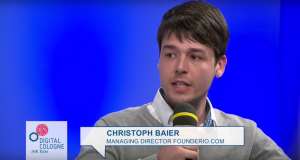
Christoph Baier
At founderio we use a software solution to bring founders together with established companies, and we also help them find their team – because finding the team is always the first problem for startups. With Ambi-Vation we focus on the second language, on the established companies, and look at how they can work with startups: with whom, and what they need to pay attention to.
Richard Gutjahr
So you're a kind of marriage market – Tinder for companies?
Christoph Baier
I prefer the Parship metaphor we heard earlier.
Richard Gutjahr
We've already heard there are two different languages: the traditional entrepreneurs who are aware but don't yet know how to implement it, and conversely the coders, who speak their own language anyway. How do you manage to synchronise them so that they get on the same level?
Christoph Baier
That is one of the biggest challenges in unlocking the potential. It starts with the fact that they are two different languages. Tobias already mentioned the superlatives that are often used by startups. The conservative Mittelstand entrepreneur may not be able to do much with "disruptive", "innovative", "new business model". On the other hand, the startup may struggle with controlling and other topics the Mittelstand focuses on. One of the first steps we take when working with companies, for example, is learning vocabulary – here is the vocabulary booklet. We usually start with motivation and then comes school. It's similar the other way round: companies face the challenge of asking what vocabulary they actually use at their site. We help them, for example, to use language that startups understand better, or to explain their vocabulary to the startups. Emojis are an idea for the future. If both sides understand each other's vocabulary, they can communicate and know what the other wants. Language is only one part, of course; culture and mutual understanding are also very important. For example, a startup is usually searching for a business model – otherwise, by definition, it is already on its way to becoming a young company or a Mittelstand company – and searching for a business model is a completely different task from exploiting one, which is the job of an established company. For instance, it must be allowed – within limits – to make mistakes. That's where Mittelstand companies bump up against it. It's also a matter of communication to say: OK, this is about a new business model, so I have to allow mistakes. Once I've found the business model I can still perfect it and polish out the mistakes, but not at the beginning.
Richard Gutjahr
Of course I immediately hear the Mittelstand entrepreneur, or someone who is already responsible for employees, saying: fine, you can experiment and blow things up, but in my case 50 people end up on the street. How do you take away those fears?
Christoph Baier
That's a difficult one. What is often done is to create a limited space in which such collaboration is possible. That's where the form of cooperation matters. As a rule, an early-stage startup won't be integrated directly into the Mittelstand company's processes; instead you start, for example, a research project in which you jointly explore a new technology. But that is often the only way to unlock such potential. Last week there was an event on 3D printing in Berlin where someone said the technology is improving by 100% per year. That's difficult, of course: if as a Mittelstand company I don't use the technology, I don't notice how it develops. Then today I might decide: startups and this technology – I'd rather leave it. There was a nice example: a startup brought along a 3D-printed chair. The Mittelstand entrepreneur grabs the chair, shakes it, and the chair breaks. That was of course a very bad moment. You have to sharpen the understanding that this is a new technology that develops very quickly. One or two years later you may be able to process metal and other materials that are suddenly super cheap, but maybe the Mittelstand entrepreneur then says: I saw that two years ago, and startups deliver such poor quality, my customers want quality. So it's important to mediate between the two so that both understand what startup means and what Mittelstand means.
Richard Gutjahr
Many successful companies have the problem that they can't run two businesses at the same time. They can't shut down the machines to experiment with 3D printers. With one they still earn their money, with the other they don't earn any yet. I'd know immediately where I'd invest my money – in what works now. But if you start innovating too late, you miss the boat?
Prof. Tobias Kollmann
At the end of the day we need companies with two speeds and two fields of focus. We have to create space for digitalisation topics in traditional companies, for example to experiment with startups as an outsourced research and development department. Because that's exactly how you have to see startups – it's the best possible way to make it clear even to a classic CFO: you're investing in innovation anyway, so do it in digital together with startups – and you know that not everything works in your own R&D either. It's also a question of where you anchor it, where in the company such a change takes place. Many companies set up digital units outside the company so as not to disrupt the traditional operations. There are many forms here too; what matters is taking up the topic, facing the challenge and simply trying it out. And I completely agree with you: the old mentality of first making absolutely sure in advance which of ten alternatives it will be simply takes too long. The startup mentality of simply trying all ten is of course a cultural change for many, and that's exactly where every entrepreneur has to decide for themselves how to manage the cultural change. Within the established system, in parallel, in new departments, by outsourcing?
Richard Gutjahr
That's where you can advise, help and bring external know-how into companies – so that even a broken chair may have been worth something in the end, because you gained those insights and that know-how at a time when you could afford to break something now and then.
Prof. Tobias Kollmann
I find the broken chair a nice image, by the way. That was also the collapse of the Neuer Markt: everyone said that's exactly why it doesn't work, we don't need to bother, and retreated into a Sleeping Beauty slumber. That was exactly the wrong thing. Judging digitalisation only by the broken chair is just as ridiculous as board members taking off their ties and thinking they're digital. We have to separate ourselves from such symbols or events and look at what is coming at us in the medium and long term – and then this is at best an interim solution.
Richard Gutjahr
Christoph, many Mittelstand companies say: we have in-house IT, they'll take care of it. You say startups tick and think a bit differently and you could benefit from that. What can outsiders bring into an established company that it probably can't achieve on its own?
Christoph Baier
IT is one topic; research is also very exciting. You have to look at what tasks startups are made for. If it's about perfecting a certain process, a startup may not be the right partner. But if it's about using a new technology that will become much stronger and more powerful in the future – perhaps the dominant technology – that I find very exciting. There a startup can play to its strengths: speed, innovative power, and also culturally, in that the established company can learn from the startup. Which methods are there, how can I do innovation? In the Mittelstand I have the feeling there is a strong focus on the existing business model. In innovation management there are two hands – people speak of ambidexterity. While one hand takes care of developing, exploiting and perfecting the existing business model – 1% faster, better and so on – a sustainably successful company should have a second hand that develops innovations in the topics of the future. Because at the end of the day, if I keep perfecting, at some point the technology reaches its limit and its importance declines; I may still gain market share, but at some point that's over too, and then the new technology arrives. This means jobs are cut in the existing technology and created in the new one. And if there are no startups or companies in Germany working on new technologies, the jobs are created elsewhere. So for society, too, it is extremely important that established companies and startups – above all B2B startups – work together.
Prof. Tobias Kollmann
What's all the more alarming, you have to say, is when you look at the studies on why the Mittelstand and industry don't face digitalisation. The top answer is defending existing structures. And the second answer is that they don't have time. Those two answers really make me feel sick. That can't be the answer, and that's exactly why it's a topic: established managers, wherever and however they act, fear the short-term effects, and their own success and pay play a role. That's why working with startups is so exciting – in a cooperation you can try things out without directly damaging your own brand, and without getting into situations where you as a manager might be labelled unsuccessful. A lot can be moved through such cooperation approaches.
Richard Gutjahr
My takeaway: experiment while the business is still running, but on protected ground, and bring some new ideas – and also new minds and startups – on board.
Question from the audience
How long does it take me to learn programming? Which languages can you learn, and what is a sensible place to start?
Christoph Baier
As a business informatics graduate I can say a little about that, though Thomas is surely the better person to ask. It depends on how good you want to be, but I think after half a year you have your first successes and can do the first things yourself. The classic entry point is HTML – which isn't a programming language at all; you can start very easily, have your first successes after a day and can design websites. Then there are different languages: at university Java is very popular; in practice, Ruby on Rails or PHP are popular too, for example.
Richard Gutjahr
I learned Python today. From my own experience as a journalist: today I left my coding course for you. Today was the first day in Hamburg – my first day of school; I learned coding for beginners, for journalists. I'm flying back on the first plane tomorrow and it continues. Dear colleagues, I'll be back tomorrow and copy my homework from my neighbour. I don't think it's wrong for anyone to train this way of thinking and understand how it works. You don't have to become the perfect coder – that's not the main goal at all – but you can at least better imagine the logic of this new digital world. Not everyone has to be able to print a chair; I at least wouldn't want to sit on my own. In coding, I learned today, it takes about two years – and then it really starts.
Question from the audience
Today is about startups, and at the beginning we heard that it's very important to network the established Mittelstand with startups so they can be the outsourced research department. In that context I found it interesting that a startup with an analogue business model was presented that hasn't digitalised itself yet. One suggestion would be to bring actual Mittelstand companies here to report on how they digitalised their business model with the help of startups, with lasting effect. That was a bit missing for me today – just as a suggestion.
Prof. Tobias Kollmann
Absolutely right, and I'd even like to extend that. When we talk about pitches, it's always startups pitching to investors because they want funding. I'd like to turn that around: startups pitching for a contract, to build a joint platform that way. I think that's something you can use as a basis to see what actually comes of it – and perhaps to develop best practices that can then be presented again. I think we quite simply need lots of these examples so that others can learn from how it's done. That may be another way.
Christoph Baier
I would especially support business relationships – they are what really matters for startups. One more example of such a collaboration: the Berlin startup sofatutor works with the publisher Cornelsen in e-learning. If you consider that South Korea discussed banning textbooks from everyday school life by 2016/2018, then in Germany – maybe we have two, three or five years more – I as Cornelsen have to ask myself what I'm actually doing if my core business is textbooks. That's very exciting: I think Cornelsen uses it on the one hand to digitalise itself, but on the other hand also to grow with the startup and benefit from its culture. I find that a very nice example.
Prof. Tobias Kollmann
Maybe we should put the idea out there right away: Spotify for school books. One subscription, all books, on any device, whatever is needed for class. Dear startups, off you go.
Question from the audience
That's a great platform you offer, Mr Baier. Unlike Berlin, the Rhineland has an enormous amount of industry – a real strength. But in the introduction you said that you also put teams together; I'd like to know more about that.
Christoph Baier
Perhaps I need to clarify: we don't put the teams together on the platform; users find each other on the website themselves. Users can publish their profile there and then communicate with other users, or publish a call: I'm looking for a potential co-founder with these skills who might also be enthusiastic about my topic. We just heard from Thomas Bachem that enthusiasm for a topic is very important. I believe very few startups – in my opinion at least – are founded for the money alone. The motivation for the topic, the vision, is an important starting point.
Marco Zingler (denkwerk)
Tobias, I think you hit exactly the right point. Startups in Germany could digitalise traditional industry much faster if there weren't such devastating procurement rules. That's the truth. The purchasing rules of German industry prevent working with startups. Risk management is so tough that nobody wants to work with newly founded companies. That also leads to the somewhat peculiar culture of thinking you can only found a startup if you get venture capital, collected after circus performances at investor conferences. The best way in Germany – and that's how we did it in 150 years of industrialisation – is really to win contracts and earn money right away. The core point, though, is that industry doesn't need to found startups or teach itself to code – it would just need to work with startups.
Prof. Tobias Kollmann
Exactly, and that's why the way doesn't go through the purchasing department. That's quite clear, because that's where most fail, and in some cases buyers may simply not understand such "uncertain", inflexible suppliers that may no longer exist tomorrow. I believe we have to position the topic differently: through R&D, and through the innovation and business development departments that exist in companies. And we need the right contacts who are available to startups. That's why DWNRW will soon have a new offer that gives startups the right contacts in the Mittelstand and industry, so that they can first talk to the right people, bypassing the purchasing departments. Our advisory board for the young digital economy has, by the way, also clearly pointed out in Berlin that the public sector must make sure not to exclude startups per se when awarding contracts. And we have at least been assured that these guidelines will be reconsidered to open that door.
Richard Gutjahr
Opening is a good keyword – providing interfaces to establish and enable the exchange.
Prof. Tobias Kollmann
Of course. Anyone who still thinks they can conquer the internet alone is, in my view, taking the wrong approach. I believe cooperation models are much, much more in focus today. And that's ultimately what startups do: network with each other, look for win-win situations – you help me, I help you – to get bigger and grow together. In my opinion that also has to be a culture that applies in the Mittelstand. We have to break away from the classic horizontal "Deutschland AG" – only the big ones among themselves, and nobody else gets into the club. That's long been filed away; we need a vertical structure of large, medium and small. Especially in digitalisation, it's mainly about speed, and the big tankers can't manage that. So it is quite simply obvious to think about other models here, and we have to bring that closer to the big ones.
Question from the audience
Speed is exactly my topic. If you look at the different ecosystems globally and compare growth rates, we would have to step on the gas a lot to come even close to the same rates. My question is, first, what is the current growth rate, and second, how would we actually have to change our structures, our education system, our investment behaviour and so on to get even close to other leagues? Because I think we are growing a little, and digital is becoming more interesting in Germany. But compared with other countries and ecosystems we are still far behind in terms of growth.
Prof. Tobias Kollmann
I can only confirm that: we're not running ahead, we're running behind. And assuming the others won't stop running, in theory we'd have to run twice as fast – and we're not doing that at the moment, quite simply because we haven't yet shaped many framework conditions so that digitalisation really moves forward seriously. Then there's education – I already outlined the whole chain where we urgently need to act – and financing, for example. We still have twenty times less venture capital than the United States, even in relative terms. We are still wary of the really big structural changes – for example adopting the UK's Enterprise Investment Scheme, where private investments in young companies are tax-deductible. We don't do that here; we are quite simply very conservative. Our culture as a whole doesn't exactly have the entrepreneurship gene: we keep training people for employment, and in the mindset of the next generation of students many only want to be employees. Very alarming figures here in NRW too: almost half still want to go into the public sector. That's not how we'll make real progress. Now you could say: that's coming from someone in the public sector – but I was a founder once, too. So I think we have to do a lot in many places. And we have to let go of something else: measures in Germany are, at the end of the day, too small globally, because Germany is too small in the digital space. We'd have to think at least in European terms, because between the big online regions of America and Asia only a European single market has any relevance. For that, though, we have to make it possible for startups to grow internationally much faster. At the moment they run into all sorts of data protection rules and legal forms for founding companies in the individual European countries. None of that helps, which is why we're not ahead right now and have to be careful not to be ground down between America and Asia, but to show our own colours. The numbers aren't there yet: of the 151 unicorns worldwide, only 14 come from Europe and only four from Germany – far too few to play along in future. So we have work to do in many places. And I have to say this clearly: of course we'd like to snap our fingers and have everything better overnight, but unfortunately that's not how it is. It's a process that takes time; we've started it in many places, but we are far from the goal and have to step up our efforts significantly.